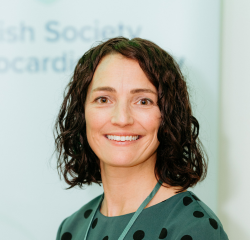
With registration for BSEcho 2025 opening soon, Dr Aimee Drane, Senior Lecturer at Swansea University, looks back on BSEcho 2024.
There were many sessions that I really enjoyed, with several key takeaways – but first, I’d like to take the opportunity to applaud the education committee for the breadth of delivery. I thought it was a smart option to have the ‘back to basics’ aspects of particular diseases or valve assessment, but then to sandwich that content with up-to-date research around the area and more specialised assessment of these diseases was really brilliant. This improved accessibility, refreshing and recapping for more experienced colleagues but giving the fundamental foundations of essential knowledge for others.
The first day was commenced with an excellent talk by Dr Maria Paton – really showcasing high-end research lead by healthcare scientists. I then attended the HFpEF session. This has got me thinking a lot more broadly about the disease and about the phenotypes of the HFpEF and how this can relate to my comparative physiology research. There really is so much we still do not understand about heart failure and in particular HFpEF; there is much work to do from a research perspective to further elucidate mechanisms, understand progress and decompensation.
I think the echo in the community session and the growing momentum of more advanced echocardiography being integrated into community services is really exciting. In fact, I have close colleagues at Swansea University who are making great strides with promoting high quality echocardiography in the community and in remote locations such as Mongolia. I think this work, incorporated with the AI aspects that were also delivered across several streams throughout the conference are really encouraging for the future direction of travel for our profession. AI is here to stay and I think as a society it is clear that we are aiming to embrace it whilst keeping patient safety and experience at the front and centre of what we do. Always evolving with medicine is essential.
Between sessions I was able to have some really motivating discussions with some of the stakeholders in AI technology, particularly the use of AI for echo templating and reporting. I think that for my research and clinical work with great apes these applications could be fundamental to providing more robust data with less inter-operator variability. The proof will be in the eating so to speak, but I am looking forward to exploring some of these options.
On the second day, the tricuspid regurgitation assessment session in the morning was fantastic. It really pulled together all of the previous and current knowledge and research around regurgitant assessment. I learnt so much in this session, the speakers were engaging and I most certainly feel more equipped to make a more solid assessment of the valve.
The Investigator of the Year award presentations were really inspiring – the winner a worthy one. It was another ingenious idea to ask the investigators to present to the whole BSE audience rather than in a secondary or tertiary track. To see clinical scientists up and presenting to such high standards is very motivating – I’m not sure there are many other medical societies like it, to be honest. The research that was being completed was good quality, meaningful, impactful research that is going to potentially improve the patients diagnostic journey – don’t we all aspire to that?
BSEcho 2024 will always be memorable for me, as the year that I was awarded Fellowship of such a great society. This means more than I can express and has certainly helped return my research ‘mojo’ as they say.
Many thanks to the BSE education committee and ‘Team Green’ for providing a great conference. You really do think of everything!
Has Aimee’s experience whet your whistle?
Check out BSEcho 2025